Local SEO for Plumbers: How to Dominate Your Service Area Without Paying Rent
Why Local SEO for Plumbers Is Different in 2026
Local SEO for plumbers operates in a fundamentally different environment than it did even two years ago. The stakes are higher, the competition is fiercer, and the platforms deciding who gets the call have changed. 76% of people who search for something nearby visit a business within a day (Google). For plumbers, that window is even tighter. When someone searches "emergency plumber near me" at 11 PM with water pooling in their basement, they're calling the first business they see. If that's not you, it's your competitor.The Emergency-Intent Problem Most Plumbers Miss
Not all plumbing searches carry the same urgency. "Burst pipe repair" and "bathroom remodel plumber" trigger completely different buyer behaviors. Emergency searches convert immediately. Planned searches involve research, comparison, and delay. Most local SEO for plumbers treats all keywords the same. That's a mistake. Emergency-intent queries demand instant visibility in Google's local pack and Google Business Profile. Planned searches reward content depth, reviews, and authority signals. The businesses winning emergency calls optimize for speed: click-to-call buttons, GBP posts highlighting 24/7 availability, and reviews mentioning response time. The businesses winning planned jobs build content around project types, cost guides, and local expertise.How AI Search Is Reshaping Plumbing Visibility
50% of Google queries now trigger AI Overviews, causing a 61% drop in organic click-through rates (DemandSage, 2025). When someone asks ChatGPT or Perplexity "best plumber in your area," the AI cites 3-5 businesses. If you're not in that group, you don't exist. AI models prioritize structured, factual content with clear expertise signals. That means schema markup, FAQ sections, and content that answers specific questions. Generic service pages don't cut it anymore. Local SEO for plumbers now requires optimization for three surfaces: Google's traditional local pack, AI search answers, and voice assistants like Siri and Alexa. Each surface pulls from different signals, but all reward the same foundation: authoritative, locally-relevant content you own.Google Business Profile Optimization That Actually Drives Calls
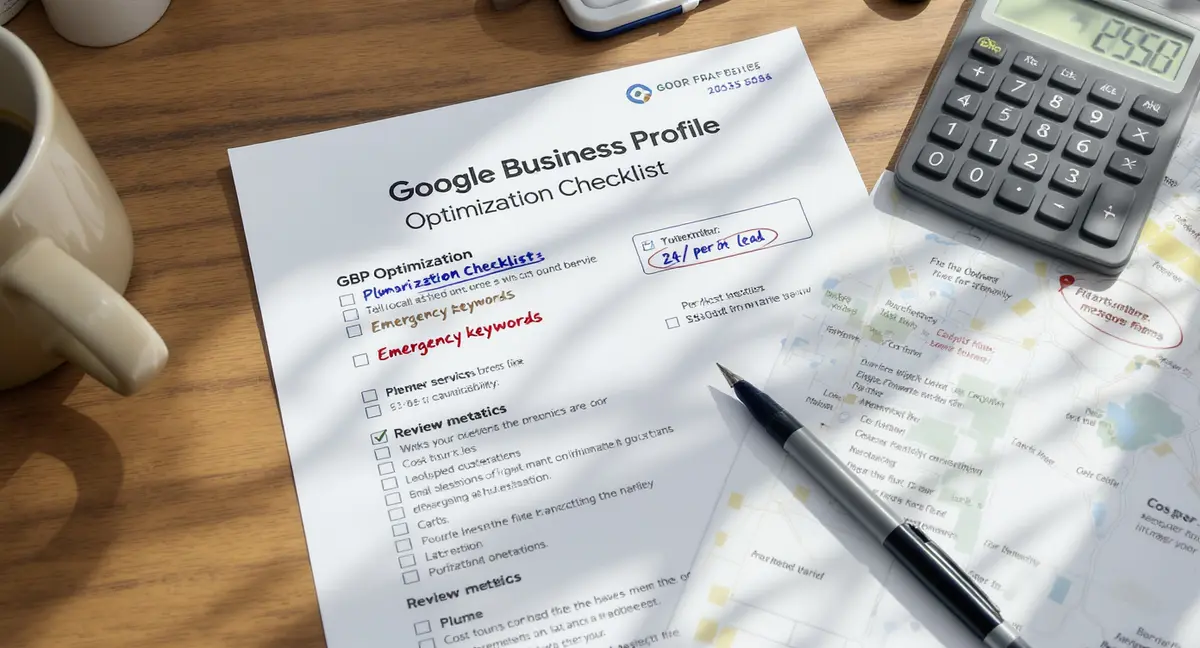
Your Google Business Profile is the single highest-leverage asset in local SEO for plumbers. GBP optimization is the #1 local ranking factor (Whitespark, 2024). Businesses with complete profiles are 70% more likely to attract location visits (Google). Yet most plumbers treat GBP as a set-it-and-forget-it listing. They fill out the basics, upload a logo, and wonder why competitors with worse websites rank higher.Category Selection and Service Area Configuration
Your primary GBP category determines which searches you're eligible for. "Plumber" is the obvious choice, but secondary categories matter. Add "Emergency plumber," "Water heater installation service," or "Drain cleaning service" based on your revenue mix. Service-area businesses face a unique challenge. You don't have a public storefront, so Google requires you to define your service area by city or radius. Be specific. A 50-mile radius dilutes your relevance. Define the exact cities and ZIP codes you serve. Businesses that serve multiple distinct markets should consider separate GBP listings for each location, even if it's the same physical office. This is compliant if you have a genuine local presence, staff, vehicles, or a service address in each area.Content Cadence: Posts, Photos, and Q&A
GBP posts expire after seven days. Businesses that post weekly see higher engagement and better local pack rankings. Post about completed jobs, seasonal services, emergency availability, and local events. Photos drive action. Listings with photos receive 42% more requests for directions and 35% more clicks to websites (Google). Upload before-and-after job photos, team photos, and vehicle photos. Tag them with location data when possible. The Q&A section is underused. Seed it with questions customers actually ask: "Do you offer same-day service?" "What areas do you cover?" "Are you licensed and insured?" Answer them yourself before competitors or trolls do. Find out if your GBP is set up to win emergency calls. Book a 30-minute scan.Service Pages and Location Content That Build Authority
Local SEO for plumbers lives or dies on the quality of your service and location pages. These pages do two jobs: rank for local search queries and convert visitors into calls. Most plumbing websites fail at both. They create thin pages stuffed with keywords, duplicate content across cities, or generic service descriptions copied from competitors.How to Structure Service Pages Without Duplication
Each service you offer deserves its own page: drain cleaning, water heater installation, sewer line repair, leak detection, bathroom remodeling. Don't lump them together. Each page should include: what the service is, when customers need it, how you deliver it, what it costs (range or starting price), and why your approach is different. Add local context. "Drain cleaning in your area" isn't enough. Mention common issues in your area, old cast iron pipes, tree root intrusion, hard water buildup. Include schema markup for LocalBusiness and Service. This helps AI models extract structured data about what you do and where you do it. Avoid the trap of creating 20 identical city pages that only swap the city name. Google penalizes thin location pages. If you serve multiple cities, write unique content for each: local landmarks, neighborhood-specific plumbing issues, city permit requirements, or local supplier partnerships.Content That Demonstrates Local Expertise
Authority in local SEO for plumbers comes from proving you know your market. Write about local building codes, seasonal plumbing issues in your region, or common problems in older homes in your area. Example: A plumber in Phoenix should write about hard water damage, monsoon-related flooding, and slab leak detection in desert climates. A plumber in Chicago should cover frozen pipe prevention, basement sump pump maintenance, and old galvanized pipe replacement. This content earns organic mentions, local backlinks, and signals to Google that you're not a national template site. You're a local operator with real expertise. Companies that publish local expertise content see 4x more backlinks than those without original insights (Backlinko). Those backlinks come from local news sites, community blogs, and industry associations, exactly the links that boost local rankings.Review Generation Systems That Run Without You
Reviews are the second-highest local ranking factor after GBP optimization. But most plumbers approach reviews reactively. They ask happy customers to leave a review and hope for the best. That's not a system. That's luck.Building a Post-Job Review Workflow
The best time to ask for a review is immediately after job completion, while the customer is still relieved the problem is fixed. Automate the ask. Send a follow-up text or email within 24 hours. Include a direct link to your Google review page. Make it one click. The easier you make it, the higher your response rate. Timing matters. Don't ask for a review before the invoice is paid. Don't ask during the job. Ask when the customer has experienced the outcome, working water heater, unclogged drain, no more leak. Track your ask rate and response rate. If you complete 100 jobs per month and only get 5 reviews, your workflow is broken. Industry benchmarks suggest a 10-15% review conversion rate is achievable with a good system.How to Respond to Reviews Without Sounding Robotic
Responding to reviews signals to Google that you're an active, engaged business. It also shows future customers how you handle problems. Respond to every review, positive and negative. For positive reviews, thank the customer by name, mention the specific service, and reinforce your value. "Thanks, John. Glad we could get your water heater replaced the same day. We know how disruptive a cold shower can be." For negative reviews, acknowledge the issue, apologize if warranted, and offer to make it right offline. Never argue. Never get defensive. Potential customers are watching how you handle conflict. Businesses that respond to reviews see higher conversion rates. According to research from Harvard Business School, responding to customer reviews can increase conversion rates by up to 12%.See How Your Business Shows Up in AI Search
Get a free AI visibility scan. See exactly where you rank on ChatGPT, Perplexity, and Google AI, and what to do about it. Get Your Free Scan. If you're auditing your entire local presence beyond plumbing-specific tactics, our SEO checklist covers the technical and content foundations that apply across all local service businesses.
The Mobile-First Conversion Problem
46% of all Google searches have local intent (Google). Most of those searches happen on mobile. If your website isn't built for mobile-first conversion, you're losing calls. Local SEO for plumbers isn't just about ranking. It's about turning visibility into revenue. A plumber who ranks #1 but has a slow, confusing mobile site will lose to a competitor who ranks #3 with a fast, call-optimized site.Click-to-Call and Form Conversion Basics
Your phone number should be clickable on every page. Use HTML tel: links so mobile users can call with one tap. Put the number in the header, footer, and at the end of every service description. Forms should be short. Name, phone, service needed, and optional message. That's it. Every additional field drops your conversion rate. Use conditional logic if you need more detail. Ask "What service do you need?" first, then show relevant follow-up questions. Don't ask for a full address if you only need a ZIP code to confirm service area. Page speed is a ranking factor and a conversion factor. If your site takes more than 3 seconds to load, 53% of mobile users will abandon it (Google). Compress images, minimize scripts, and use a fast host.Emergency vs. Planned-Service UX
Emergency visitors and planned visitors need different experiences. Someone searching "emergency plumber" at midnight doesn't want to read a 2,000-word guide. They want a phone number and proof you're available now. Create a dedicated emergency landing page. Headline: "24/7 Emergency Plumbing, We Answer Now." Subhead: "Serving your area Since ." One big click-to-call button. Social proof: "Average response time: 45 minutes." For planned services, provide depth. Cost guides, project timelines, financing options, and case studies build confidence. These visitors are comparing you to competitors. Give them reasons to choose you beyond price.Tracking What Actually Matters
Most plumbers track the wrong metrics. They obsess over keyword rankings and organic traffic while ignoring the numbers that drive revenue: calls, form fills, and booked jobs. Local SEO for plumbers should be measured by business outcomes, not vanity metrics.Call Tracking and Attribution
Use call tracking numbers on your website, GBP, and ads. This lets you see which channels drive calls. You'll discover that your GBP listing drives 60% of calls, your homepage drives 20%, and your blog drives 5%. That data tells you where to invest. Track call outcomes. Not every call is a booked job. Some are spam, some are price shoppers, some are out of your service area. Measure conversion rate from call to booked job. If you're getting 100 calls per month but only booking 30 jobs, you have a sales problem, not an SEO problem. Google Business Profile Insights shows how many people called you directly from your listing, requested directions, or visited your website. Track these monthly. If GBP calls are flat or declining, your profile needs work.Form Fills, Map Views, and Directions Requests
Google Search Console shows which queries trigger your website in search results and how often people click. Filter by location-based queries. Track impressions and click-through rate for your top 20 local keywords. Map views and directions requests are leading indicators. If someone requests directions to your business, they're likely coming. Track this in GBP Insights. If directions requests spike but calls don't, your in-person conversion process needs attention. Form fills are easier to track than calls. Use Google Analytics goals or your CRM to measure form submissions by source. Break it down: organic search, GBP, direct traffic, referral. This shows which channels drive research-mode leads vs. ready-to-buy leads. Only 8% of marketers feel confident they can measure ROI from their marketing efforts (Firework, 2025). Don't be part of that 92%. Build a dashboard that tracks calls, form fills, booked jobs, and revenue by source. Review it monthly.What It Takes to Own Your Local Visibility
Most plumbers rent their visibility. They pay an agency $1,500-$3,000 per month for SEO services. When they stop paying, the work stops. The content, the process, the data, it all stays with the agency. That's not ownership. That's dependency.The Installed-System Alternative
Local SEO for plumbers can be built as infrastructure you own. The content lives on your domain. The workflows run in your tools. The data belongs to you. When the build is done, the system keeps producing results. This is how platforms like Strategyc's Content & Visibility Engine work. The system is installed on your infrastructure, your website, your AI accounts, your analytics. You control publishing pace. You own the content. The system is designed to perform for 12+ months after installation. Not every business needs this. If you're in a low-competition market and your GBP listing alone drives enough calls, you might not need a content engine. But if you're in a competitive metro area where 10 plumbers fight for the same searches, owned infrastructure compounds over time while rented services reset to zero when you stop paying.What You Can Build In-House vs. What You Should Hire Out
You can handle GBP optimization, review requests, and basic on-page SEO in-house. These tasks are repetitive and process-driven. Create checklists, train your admin, and execute. Content production is harder. Writing 8-10 local authority articles per quarter requires research, keyword planning, and editorial quality. Most plumbing businesses don't have the time or skill to do this consistently. Technical SEO, schema markup, site speed optimization, crawl error fixes, requires specialized knowledge. Hire a contractor or use a platform that handles it as part of the build. The question isn't "Can I do this myself?" It's "What's the highest-value use of my time?" If you're a plumber who loves writing and has 10 hours per week for content, build it yourself. If you'd rather run service calls and grow your team, install a system or hire it out.The Bottom Line
Local SEO for plumbers in 2026 is a three-surface game: Google's local pack, AI search answers, and voice assistants. The businesses winning across all three own their content, optimize for emergency and planned intent separately, and measure outcomes that matter, calls, jobs, revenue. GBP optimization is table stakes. Service and location pages must demonstrate local expertise, not just keyword density. Reviews need a system, not hope. Mobile conversion is as important as ranking. And tracking must connect visibility to revenue. The choice is simple: rent your visibility from an agency that resets to zero when you stop paying, or build infrastructure you own that compounds over time.Frequently Asked Questions
How long does local SEO for plumbers take to show results?
Most plumbing businesses see measurable improvement in GBP visibility and local pack rankings within 8-12 weeks of consistent optimization. Content-driven authority builds over 6-12 months. Emergency-intent keywords can rank faster than planned-service keywords due to lower competition and higher local signals. Plumbers operating multiple service areas under one brand face similar challenges to franchise operators balancing corporate consistency with local relevance, a dynamic we explore in depth in our guide to local SEO for franchises. If you're a plumbing business owner trying to understand how SEO fits into your broader growth strategy without getting lost in jargon, our SEO for business owners playbook translates technical concepts into business decisions.
Do I need separate location pages for every city I serve?
Only if you can write unique, valuable content for each city. Thin pages that only swap the city name hurt more than they help. Focus on cities where you have meaningful job volume, local partnerships, or unique expertise. Three strong location pages outperform ten weak ones. The local expertise content that earns backlinks and authority signals requires a systematic approach to topic selection and publishing cadence, which is why a structured blog strategy for SEO becomes essential for plumbers serious about long-term visibility. While plumbers and lawyers operate in different industries, both face the same challenge of capturing high-intent local searches where timing determines who gets the client, a parallel we examine in our analysis of SEO keywords for lawyers.
What does it take to own my local visibility infrastructure instead of renting it?
Owning your visibility means the content lives on your domain, the workflows run in your tools, and the data belongs to you. You need a content system, technical SEO foundation, and tracking infrastructure. Build it in-house if you have time and skill, or install a system that hands you the keys when it's done.
How many Google reviews does a plumbing company need to rank locally?
There's no magic number, but competitive markets require 50+ reviews to compete in the local pack. Review velocity matters more than total count. A business with 30 reviews in the past 6 months often outranks one with 100 reviews from 3 years ago. Aim for 5-10 new reviews per month.
Can I measure ROI from local SEO if most of my leads come through phone calls?
Yes. Use call tracking numbers on your website and GBP listing to attribute calls by source. Track call outcomes, booked jobs, not just total calls. Measure revenue per source channel. If organic search drives 40 calls per month and 15 convert to jobs at $500 average, that's $7,500 in monthly revenue you can attribute to SEO.