How an Ecommerce SEO Expert Drives Revenue Without Paid Ads
The short answer: An ecommerce SEO expert builds organic visibility systems that deliver compounding customer growth without ongoing ad spend. Ecommerce SEO experts optimize product pages, technical infrastructure, and content strategy across keyword stages from discovery to purchase intent. Success in this space comes down to platform-specific optimization, structured data implementation, and content strategy beyond product descriptions. SEO delivers 15x ROI compared to paid ads, with 68% of ecommerce traffic coming from organic search.
An ecommerce SEO expert builds visibility systems that deliver customers without burning ad budget every month. While competitors rent traffic through Google Ads and Facebook campaigns, businesses that own their organic search infrastructure see compounding returns. The difference shows up fast: 68% of ecommerce traffic comes from organic search, and SEO delivers 15x ROI compared to paid ads (WebFX, 2025). That gap widens when you factor in customer acquisition cost. Paid traffic stops the moment you stop paying. Organic visibility compounds. If you're implementing these strategies yourself, start with a complete ecommerce SEO checklist that covers technical fixes, content optimization, and conversion tracking in priority order.
Most ecommerce businesses treat SEO as a side project or hand it to a freelancer who optimizes five product pages and disappears. That approach misses the structural advantage SEO provides. An ecommerce SEO expert doesn't just tweak meta descriptions. They architect content systems that capture search demand at every stage of the buyer path, from discovery queries to product comparisons to purchase-intent searches. They optimize for Google, AI search platforms like ChatGPT and Perplexity, and voice assistants that now influence purchasing decisions.
This article breaks down what separates effective ecommerce SEO from surface-level optimization, how to evaluate expertise when you're ready to hire, and why ownership of your visibility infrastructure matters more than renting monthly services. You'll see the tactics that produce measurable revenue growth, the platforms where ecommerce SEO works hardest, and the mistakes that tank results before they start.
What an Ecommerce SEO Expert Does for Your Store
An ecommerce SEO expert structures your entire site to capture buyer intent at scale. That means optimizing product pages, category pages, blog content, and technical infrastructure so search engines understand what you sell and who needs it. The work starts with keyword research that maps to actual purchase behavior, not just high-volume vanity terms. A qualified ecommerce SEO expert identifies long-tail queries like "best running shoes for flat feet under $100" instead of chasing impossible keywords like "running shoes."
| Factor | What it is | Impact |
|---|---|---|
| Product Page Optimization | Unique descriptions, schema markup, image optimization for each SKU | Captures buyer intent at scale; drives 13x more traffic than unoptimized sites |
| Technical Infrastructure | Site speed, mobile-first indexing, structured data, URL canonicalization | Determines search ranking and conversion rates; top 3 positions capture 54.4% of clicks |
| Content Strategy Beyond Products | Buying guides, comparisons, tutorials, reviews, AI-optimized editorial | Attracts top-of-funnel searchers; feeds AI platforms with 120x impression increases |
| Platform-Specific Tactics | Shopify apps, WooCommerce caching, BigCommerce schema customization | Avoids implementation delays; matches optimization to platform constraints |
| Category Pages as Pillar Content | 200-300 word descriptions, internal linking, faceted nav without duplicates | Outrank product pages for broader terms; capture 44% of shopper search starts |
Product page optimization forms the foundation. Every product needs unique descriptions written for humans and search engines, not manufacturer copy pasted across 500 SKUs. Schema markup tells Google your price, availability, and review ratings so rich snippets appear in search results. Image optimization matters more in ecommerce than any other vertical because visual search and Google Shopping depend on fast-loading, properly-tagged images. According to BigCommerce (2025), ecommerce sites with optimized SEO see 13x more traffic than non-optimized competitors.
Platform-Specific Optimization Strategies
Shopify, WooCommerce, BigCommerce, and Magento each require different technical approaches. An ecommerce SEO expert knows how to work within platform constraints without breaking functionality. Shopify stores need URL structure fixes because the platform adds "/collections/" and "/products/" to every path. WooCommerce requires speed optimization through caching plugins and database cleanup. BigCommerce handles technical SEO better out of the box but needs custom schema implementation for complex product variants.
Platform choice affects how fast you can implement changes. Shopify limits access to server-level configurations, so an ecommerce SEO expert works around those restrictions using apps and theme modifications. WooCommerce gives full control but demands more technical maintenance. The best experts match optimization strategy to your platform's capabilities rather than forcing a one-size-fits-all approach. Mobile commerce sales hit $710 billion in 2026 (Statista, 2025), making mobile-first optimization non-negotiable regardless of platform.
Category Pages as Revenue Drivers
Category pages often outrank individual product pages for broader search terms, yet most stores treat them as simple product grids. An ecommerce SEO expert transforms category pages into pillar content with descriptive introductions, buying guides, and filtering options that improve user experience and search visibility. A well-optimized category page for "women's running shoes" should include 200-300 words explaining fit considerations, terrain types, and feature comparisons before displaying products.
Internal linking from category pages to product pages distributes authority and helps Google understand your site hierarchy. Breadcrumb navigation with schema markup shows search engines how your catalog organizes. The ecommerce SEO expert also optimizes faceted navigation so filter URLs don't create duplicate content issues. Data from Search Engine Journal (2026) shows that 44% of online shoppers begin their process with search engines, not marketplaces or social media. Category pages capture that top-of-funnel demand.
Technical Infrastructure That Separates Winners from Losers
Site speed determines whether you compete or get buried. Google's Core Web Vitals measure Largest Contentful Paint, Interaction to Next Paint, and Cumulative Layout Shift. Ecommerce sites that fail these metrics lose rankings and conversions simultaneously. An ecommerce SEO expert audits your hosting environment, image compression, JavaScript execution, and third-party scripts that slow page loads. Research from Backlinko (2025) confirms that the top three Google positions capture 54.4% of all clicks, and slow sites rarely crack the top five.
Mobile-first indexing means Google evaluates your mobile site before your desktop version. If your mobile experience lags, your rankings suffer across all devices. This hits ecommerce especially hard because mobile shoppers expect instant load times and thumb-friendly navigation. An ecommerce SEO expert implements responsive design, touch-friendly buttons, and streamlined checkout flows that work on screens under six inches.
Structured Data for Product Visibility
Schema markup tells search engines exactly what your content represents. Product schema includes price, availability, brand, SKU, review ratings, and shipping details. When implemented correctly, this data powers rich snippets that display star ratings and pricing directly in search results. Those boosted listings increase click-through rates by 20-30% compared to plain text results. Understanding ecommerce SEO pricing helps you evaluate whether an agency's proposal matches the scope of work your store actually needs.
An ecommerce SEO expert also implements breadcrumb schema, organization schema, and FAQ schema where relevant. AI search platforms like ChatGPT and Perplexity prioritize content with clear structured data because it's easier to extract and cite. Research from Princeton and Georgia Tech (KDD, 2024) shows that schema markup improves AI visibility by 30-40%. The ecommerce SEO expert validates schema using Google's Rich Results Test to ensure proper implementation.
Fixing Duplicate Content and Crawl Budget Issues
Ecommerce sites generate duplicate content through product variants, filter URLs, and pagination. An ecommerce SEO expert uses canonical tags to tell Google which version of a page is the primary one. Without canonicalization, your site wastes crawl budget on duplicate URLs instead of indexing valuable product pages. Large catalogs with thousands of SKUs need careful robots.txt configuration and XML sitemap prioritization.
Session IDs, tracking parameters, and sort filters create infinite URL variations that confuse search engines. The expert implements URL parameter handling in Google Search Console and uses rel="nofollow" on low-value filter combinations. Clean URL architecture improves crawl efficiency and concentrates authority on pages that drive revenue. Stores that fix technical SEO issues see traffic increases within 60-90 days as Google re-crawls and re-indexes the cleaned-up site.
Content Strategy Beyond Product Descriptions
Product pages alone don't capture the full search demand in your market. An ecommerce SEO expert builds educational content that answers buyer questions before purchase decisions happen. Buying guides, comparison articles, how-to tutorials, and industry trend pieces attract traffic from informational queries that convert later. A store selling camping gear should publish content like "How to Choose a Sleeping Bag for Winter Camping" to capture researchers who aren't ready to buy today but will remember your brand when they are.
This content also feeds AI search platforms. When someone asks ChatGPT or Perplexity "what's the best espresso machine under $500," the AI cites sources with detailed comparisons and original findings, not just product pages. Ecommerce businesses that publish editorial content alongside their catalog get cited more often. enterprise SEO platform (2025) reports that early AI search adopters see 120x impression increases and 800% year-over-year traffic growth from large language models.
User-Generated Content as SEO Fuel
Customer reviews add unique content to product pages and improve conversion rates. An ecommerce SEO expert encourages review collection through post-purchase emails and incentive programs. Reviews provide fresh content signals that tell Google your products are actively purchased and discussed. They also include natural long-tail keywords that customers use but you might not think to target.
Q&A sections on product pages serve the same function. When shoppers ask "Does this jacket run small?" and other customers answer, you're building indexed content that matches real search queries. The expert implements review schema so star ratings appear in search results. Sites with visible review ratings see higher click-through rates because social proof influences decision-making even before the visitor lands on your page.
Blog Content That Drives Discovery Traffic
A strategic blog captures top-of-funnel traffic that product pages miss. An ecommerce SEO expert identifies content gaps in your market and creates articles that rank for high-volume informational queries. A furniture store might publish "Small Space Living Room Ideas" to attract apartment dwellers who later browse sofas. The blog builds brand awareness and authority while product pages handle conversion.
Companies that blog consistently get 55% more website visitors (HubSpot State of Marketing, 2024). The key is connecting blog topics to your product catalog through internal links. Every blog post should link to 2-3 relevant category or product pages. This distributes authority and guides readers from educational content to purchase opportunities. The ecommerce SEO expert also optimizes blog posts for featured snippets and People Also Ask boxes that dominate search results.
Measuring Results and Proving ROI
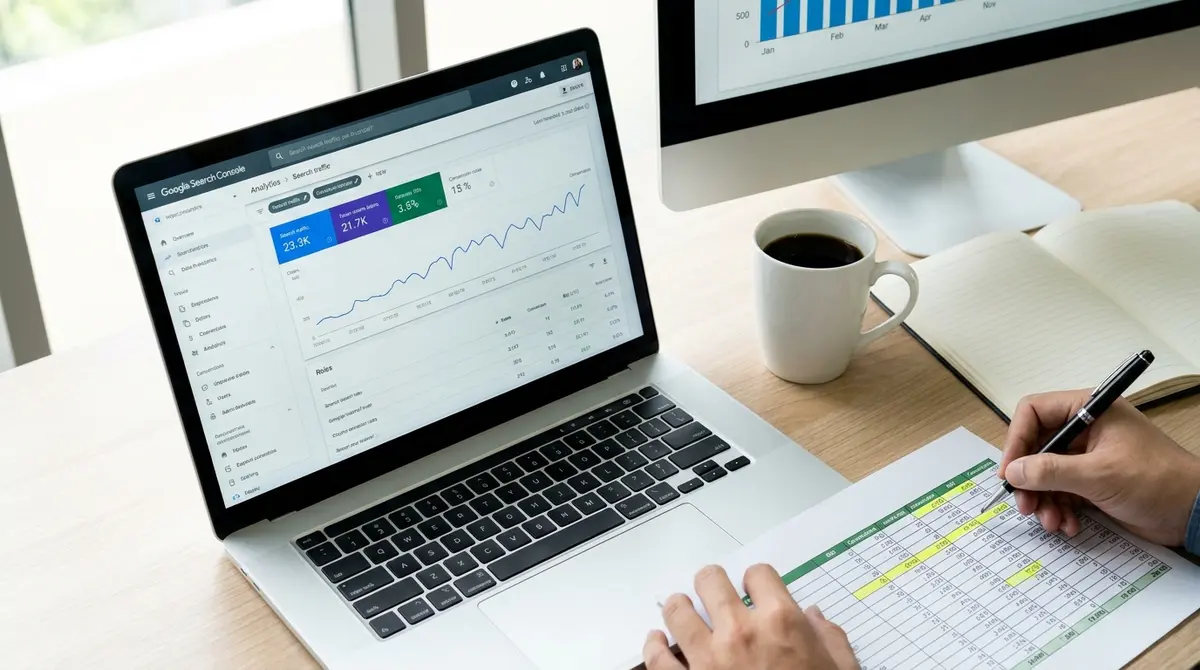
An ecommerce SEO expert tracks organic traffic, keyword rankings, conversion rates, and revenue attribution. Google Analytics 4 shows which organic landing pages drive purchases and how much revenue each page generates. Google Search Console reveals which queries trigger impressions and clicks. The expert segments data by device, location, and landing page type to identify what's working and what needs adjustment.
Conversion rate optimization runs parallel to SEO. Traffic without conversions wastes effort. The ecommerce SEO expert analyzes on-page behavior through heatmaps and session recordings to spot friction points. They test product page layouts, CTA placement, trust signals, and checkout flows. According to SingleGrain (2025), AI-sourced visitors convert at 27% compared to 2.1% from traditional search, highlighting the importance of optimizing for emerging traffic sources.
Timeline Expectations for Organic Growth
SEO delivers compounding results, not overnight wins. Most ecommerce sites see measurable traffic increases within 3-6 months after implementing technical fixes and content optimization. Competitive markets take longer. An ecommerce SEO expert sets realistic expectations based on your industry, domain authority, and current site health. New stores need 6-12 months to build authority. Established stores with technical issues see faster improvements once problems get fixed. Stores that master AI SEO for ecommerce position themselves to capture purchase-intent traffic from language models that increasingly influence buying decisions.
Revenue impact follows traffic growth. As organic traffic increases, so do conversions if your site experience supports it. The expert monitors revenue per session and average order value to ensure traffic quality improves alongside quantity. SEO leads close at 14.6% compared to 1.7% for outbound leads (Search Engine Journal), proving that organic visitors arrive with higher purchase intent than cold prospects.
Attribution Challenges and Solutions
Multi-touch attribution complicates ROI measurement because customers interact with multiple channels before purchasing. Someone might discover your brand through organic search, leave, return via email, and convert through a retargeting ad. The ecommerce SEO expert uses GA4's attribution models to assign credit appropriately. First-click attribution shows which channel started the path. Last-click shows what closed the sale. Data-driven attribution distributes credit based on actual conversion patterns.
Organic search typically plays an early-stage role in the customer experience. An ecommerce SEO expert demonstrates value by tracking assisted conversions, not just last-click revenue. They also monitor branded vs. non-branded search growth. Increasing non-branded traffic proves the SEO strategy is expanding your market reach beyond people who already know your name. Tools like Google Search Console and GA4 provide the data needed to build this narrative.
Ready to take the next step with Strategyc?
Our team is ready to help you achieve your goals. Get Your Free Scan.
In-House vs. Hiring an Ecommerce SEO Expert
Building ecommerce SEO capabilities in-house requires hiring specialists, training existing staff, and allocating time for implementation. Small teams struggle to balance SEO with daily operations. An ecommerce SEO expert brings immediate expertise without the overhead of full-time salaries, benefits, and training costs. They've solved the problems you're facing across multiple clients and industries.
The in-house approach works if you have the budget for dedicated SEO staff and the patience for a learning curve. Most ecommerce businesses operate lean and can't justify a full-time SEO hire until revenue reaches seven figures. Freelancers and consultants fill the gap but require management and clear project scopes. The average SEO agency retainer runs $1,500-$5,000 per month for SMBs (backlink analysis software, 2024), which adds up fast without guaranteed results.
What to Look for When Evaluating Expertise
An ecommerce SEO expert should demonstrate platform-specific experience with your ecommerce system. Ask for case studies showing traffic and revenue growth for stores similar to yours. Check their understanding of technical SEO, content strategy, and conversion optimization. Generic SEO knowledge doesn't translate to ecommerce without understanding product catalogs, inventory management, and purchase behavior.
Request a technical audit before signing any agreement. A qualified ecommerce SEO expert will identify specific issues on your site and explain how to fix them. Avoid anyone promising first-page rankings in 30 days or guaranteeing specific positions. SEO outcomes depend on competition, content quality, and technical execution. Realistic experts set expectations based on data, not hype. They should also explain how they'll measure success and report results.
Ownership vs. Renting Your Visibility
Traditional agency models create dependency. You pay monthly retainers for ongoing services, but the knowledge, systems, and content often stay with the agency when you leave. An ecommerce SEO expert who installs systems you own provides more sustainable value. This means building content workflows, training your team, and creating documentation so you can maintain momentum after the engagement ends.
Platforms like Strategyc take this approach by installing owned content systems rather than offering monthly retainers. The business controls the infrastructure, content, and publishing cadence. Services end, but systems compound. If SEO is critical to your ecommerce growth, it should be infrastructure you own, not a service you rent. The 38% annual churn rate at SEO agencies (Focus Digital, 2025) shows how often businesses realize they're paying for access, not ownership.
AI Search and the Future of Ecommerce Visibility
AI search platforms like ChatGPT, Perplexity, and Google AI Overviews are reshaping how shoppers discover products. When someone asks "what's the best blender for smoothies," AI systems cite 3-5 sources instead of showing ten blue links. If your ecommerce store isn't in that citation group, your competitor is. An ecommerce SEO expert optimizes for Generative Engine Optimization (GEO) by structuring content with clear facts, citations, and schema markup that AI models can extract and reference.
Voice search through Siri, Alexa, and Google Assistant follows similar patterns. Shoppers ask specific questions and expect direct answers. Product pages optimized for voice search include FAQ sections, natural language descriptions, and structured data that voice assistants can read aloud. Research shows 50% of Google queries now trigger AI Overviews, causing a 61% drop in organic click-through rates for traditional results (DemandSage, 2025). The ecommerce SEO expert adapts strategy to capture visibility in these new formats. The same visibility principles that drive plumber SEO success apply to ecommerce: own your organic infrastructure instead of renting traffic month after month.
Optimizing for AI Citations and Voice Results
AI models prioritize content with factual density, clear attribution, and section-based formatting. An ecommerce SEO expert structures product pages and blog content so AI can extract key information easily. This means using H2/H3 headings that ask and answer questions, bullet lists that summarize features, and comparison tables that present data clearly. The expert also implements FAQ schema so voice assistants can pull answers directly from your content.
Editorial content performs better than pure product pages in AI search. When someone asks for buying advice, AI cites guides and comparisons more often than individual product listings. An ecommerce SEO expert balances product optimization with educational content that positions your brand as an authority. This dual approach captures both informational queries and transactional searches.
Preparing for Zero-Click Search Dominance
Zero-click searches provide answers directly in search results without requiring a click to your site. Featured snippets, People Also Ask boxes, and AI Overviews all reduce traditional organic traffic. An ecommerce SEO expert adapts by optimizing for brand visibility even when clicks decline. This includes claiming and optimizing your Google Business Profile, building brand search demand through content, and ensuring your products appear in Google Shopping feeds.
The shift doesn't eliminate SEO's value. It changes the metrics. Impressions and brand awareness matter as much as clicks when AI platforms cite your store as a trusted source. Shoppers who see your brand recommended by ChatGPT or Google AI develop trust before they ever visit your site. The ecommerce SEO expert measures success through branded search growth, direct traffic increases, and citation frequency in AI platforms, not just organic clicks.
The Bottom Line on Ecommerce SEO Expertise
An ecommerce SEO expert builds visibility infrastructure that delivers customers without recurring ad spend. They optimize technical foundations, structure content for AI search, and create systems that compound over time. The difference between surface-level optimization and strategic SEO shows up in revenue, not just traffic numbers. Businesses that own their organic visibility infrastructure see 15x ROI compared to paid advertising and capture the 68% of ecommerce traffic that comes from search engines.
Choosing between in-house, freelance, or installed systems depends on your budget, timeline, and long-term strategy. Monthly retainers create dependency. Installed systems create ownership. The businesses winning in ecommerce SEO treat it as infrastructure, not a service. They invest in content engines that keep producing results after the initial engagement ends. AI search is reshaping discovery right now. The stores that adapt early will dominate the citation groups that AI platforms recommend. The ones that wait will watch competitors capture that visibility.
If you're ready to see where your store stands in Google, AI search, and voice platforms, book a 30-minute Content & Visibility Scan. You'll get a clear picture of your current visibility and what it takes to compete in 2026 search.
Frequently Asked Questions
What does an ecommerce SEO expert charge for optimization services?
Costs vary widely based on scope and expertise. Freelancers charge $50-$150 per hour. Monthly retainers for ecommerce SEO range from $1,500 to $5,000 for small to mid-sized stores. Project-based work for technical audits and implementation runs $3,000-$15,000 depending on catalog size and platform complexity.
How long before I see revenue growth from ecommerce SEO?
Most stores see measurable traffic increases within 3-6 months after implementing technical fixes and content optimization. Revenue impact follows traffic growth. Competitive markets take longer. New stores need 6-12 months to build authority. Established stores with technical issues improve faster once problems are resolved.
Can I build ecommerce SEO infrastructure in-house?
Yes, if you have budget for dedicated SEO staff and time for a learning curve. Small teams struggle to balance SEO with daily operations. Hiring an ecommerce SEO expert provides immediate expertise without full-time overhead. In-house works best when revenue supports dedicated roles and you want long-term control over strategy.
What's the difference between ecommerce SEO and regular SEO?
Ecommerce SEO focuses on product catalogs, category pages, faceted navigation, and purchase-intent keywords. It requires platform-specific optimization for Shopify, WooCommerce, or Magento. Regular SEO emphasizes blog content and service pages. Ecommerce SEO also prioritizes conversion rate optimization alongside traffic growth because revenue, not just visits, determines success.
How do I measure ROI from organic ecommerce traffic?
Use Google Analytics 4 to track revenue by traffic source. Segment organic search as a channel and monitor revenue per session, conversion rates, and average order value. Google Search Console shows which queries drive clicks. Compare organic revenue to your SEO investment over 12 months. SEO leads close at 14.6% versus 1.7% for outbound, proving higher intent and better ROI.